If you are looking for a home loan in Kolkata, the interest rate is the number that changes your total cost the most, and it has just moved. This guide explains where rates stand in November 2026, what lenders advertise and what most borrowers are actually offered, what decides your own rate, what a change does to your EMI, and how to get a lower one. Rates move often, so treat the figures here as a snapshot and check each lender’s own page. For loan limits, down payment and EMI examples, see our home loan and EMI guide.
Is there a separate home loan interest rate in Kolkata?
No. A search for the home loan interest rate in Kolkata or home loan rates in Kolkata gives the same answer as a search for any other city, because banks and housing finance companies price their loans nationally. What is local in Kolkata is the property: the lender will have the flat valued and its legal papers checked, and a local branch or agent usually handles the file. The rate itself depends on you, the loan and the lender, not on the city. See our checklist of documents to check before buying a flat for what lenders look at.
Where rates stand in November 2026
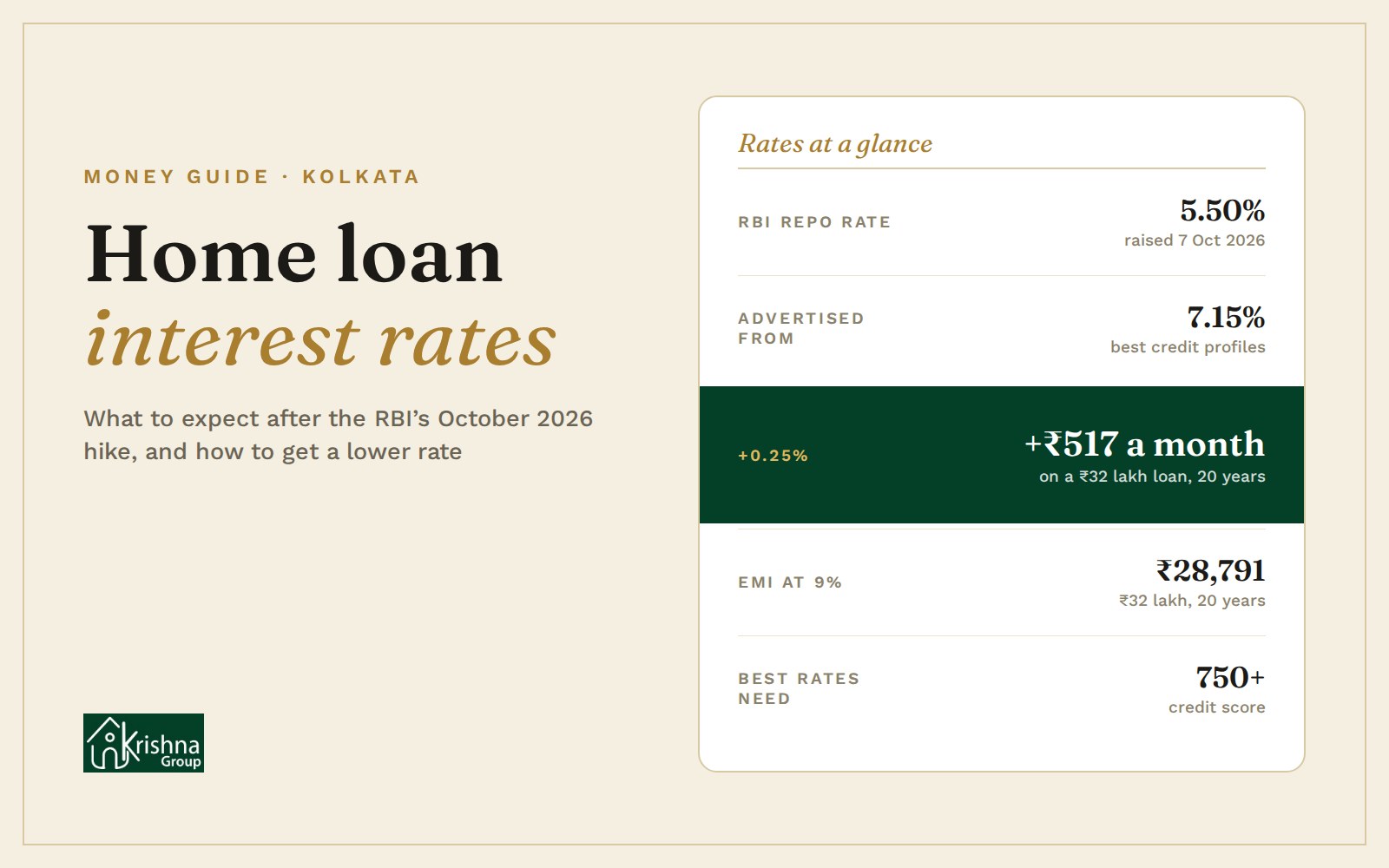
- Repo rate: 5.50%. The RBI’s Monetary Policy Committee raised it from 5.25% on 7 October 2026 by a unanimous vote, and changed its stance from “neutral” to “calibrated tightening”. The next meeting is scheduled for 2–4 December 2026.
- Floating loans reset. New floating-rate home loans are linked to an external benchmark, usually the repo rate, so banks raised their rates from 8 October 2026. Housing finance companies use their own benchmarks and may change rates at a different time.
Here is what lenders were advertising, as reported by comparison sites in October and early November 2026. These are best-case starting rates for borrowers with strong credit scores and stable income, and some were collected before the hike:
| Lender | Advertised starting rate | Note |
|---|---|---|
LIC Housing Finance | From 7.15% | Housing finance company, with its own benchmark |
Bank of Baroda | From about 7.20–7.40% | Public-sector bank |
State Bank of India | From about 7.25–7.50%, up to 8.80% | A range of 7.50–8.80% was quoted from 15 October 2026 |
HDFC Bank | From 7.45% | Private bank |
ICICI Bank | From 7.70–7.80% for pre-approved customers | Its own rate page listed 8.75–9.65% for most salaried borrowers up to ₹35 lakh, valid to 31 October 2026 |
Compiled on 5 November 2026 from comparison sites and ICICI Bank’s own rate page. Starting rates are not what everyone gets. One tracker put average rates at about 8.65–9.60%. Always check the lender’s current page.
What decides the home loan interest rate you are offered
- The benchmark plus the lender’s spread. Your rate is the benchmark (usually the repo rate) plus a spread the lender sets for you. Ask for the spread in writing.
- Your credit score. A score of 750 or more is generally needed for the best rates. ICICI Bank’s own page, for example, showed a rate of 8.75% for a salaried borrower with a score of 750–800, and the rate rises for lower scores.
- Salaried or self-employed. Self-employed borrowers are often quoted slightly more. On the same page, the rate for a score of 750–800 was 8.85% for the self-employed, against 8.75% for the salaried.
- The loan size and how much you put down. A smaller loan against the flat’s value is safer for the lender. Our home loan EMI calculator shows the maximum loan and the down payment for a flat.
- The tenure. A longer tenure lowers the EMI but raises the total interest.
- Fees. Processing fees were quoted at about 0.25–0.5% of the loan plus taxes, so compare the total cost and not only the rate.
What a change in rate does to your EMI
Here is the effect on a ₹32 lakh loan, the maximum on a ₹40 lakh flat, over 20 years:
| Interest rate | EMI per month | Total interest over 20 years | EMI against 9% |
|---|---|---|---|
7.5% | ₹25,779 | ₹29,86,956 | −₹3,012 |
8% | ₹26,766 | ₹32,23,860 | −₹2,025 |
8.5% | ₹27,770 | ₹34,64,882 | −₹1,021 |
9% | ₹28,791 | ₹37,09,895 | Base case |
9.5% | ₹29,828 | ₹39,58,768 | +₹1,037 |
10% | ₹30,881 | ₹42,11,366 | +₹2,089 |
Illustrative. Your lender’s rate, fees and tenure will differ. Try your own numbers in our home loan EMI calculator.
Every 0.25% adds about ₹517 a month and about ₹1,23,962 over 20 years on this loan. After a repo hike, a lender may raise your EMI or lengthen your tenure, so ask which it will do. It is wise to check that you could still afford the EMI at a rate 1% higher than today’s: at 10%, this loan’s EMI is ₹30,881, which is ₹2,089 more than at 9%.
Floating or fixed rate?
- Floating loans are linked to the benchmark and change when it does. They are the usual choice for home loans and usually start lower. Ask how often the rate resets and whether the spread is fixed.
- Fixed rates are usually higher and often fixed only for an initial period, after which they may become floating. Read the terms carefully before you accept one.
Whichever you choose, ask about foreclosure and part-prepayment charges, and make sure the sanction letter states them.
How to get a lower home loan rate in Kolkata
- Check your credit report months before you apply, correct any errors, and avoid new loans or card applications. Aim for 750 or more.
- Compare banks and housing finance companies on the same loan amount and tenure, and compare the rate, the spread and the fees together.
- Put down more. A larger down payment means a smaller loan and, at some lenders, a better rate.
- Negotiate. Show a competing offer and ask for a lower rate or a waived processing fee.
- Choose the tenure carefully. A shorter tenure means a higher EMI but far less interest.
- Prepay when you can, and later ask whether switching your loan to a cheaper rate would save more than it costs.
Do not chase the lowest advertised number. The rate in your sanction letter, with the fees, is what counts.
Should you wait for rates to fall?
Nobody can time rates. The RBI has moved to a “calibrated tightening” stance, which signals that cuts are not expected soon, but that can change at each meeting. What you control is your own budget: borrow an amount you can comfortably repay even at a higher rate, and remember that you can usually move your loan to a better rate later. A flat you can afford at today’s rate and at 1% higher is a safe purchase.
Before you apply for a home loan in Kolkata
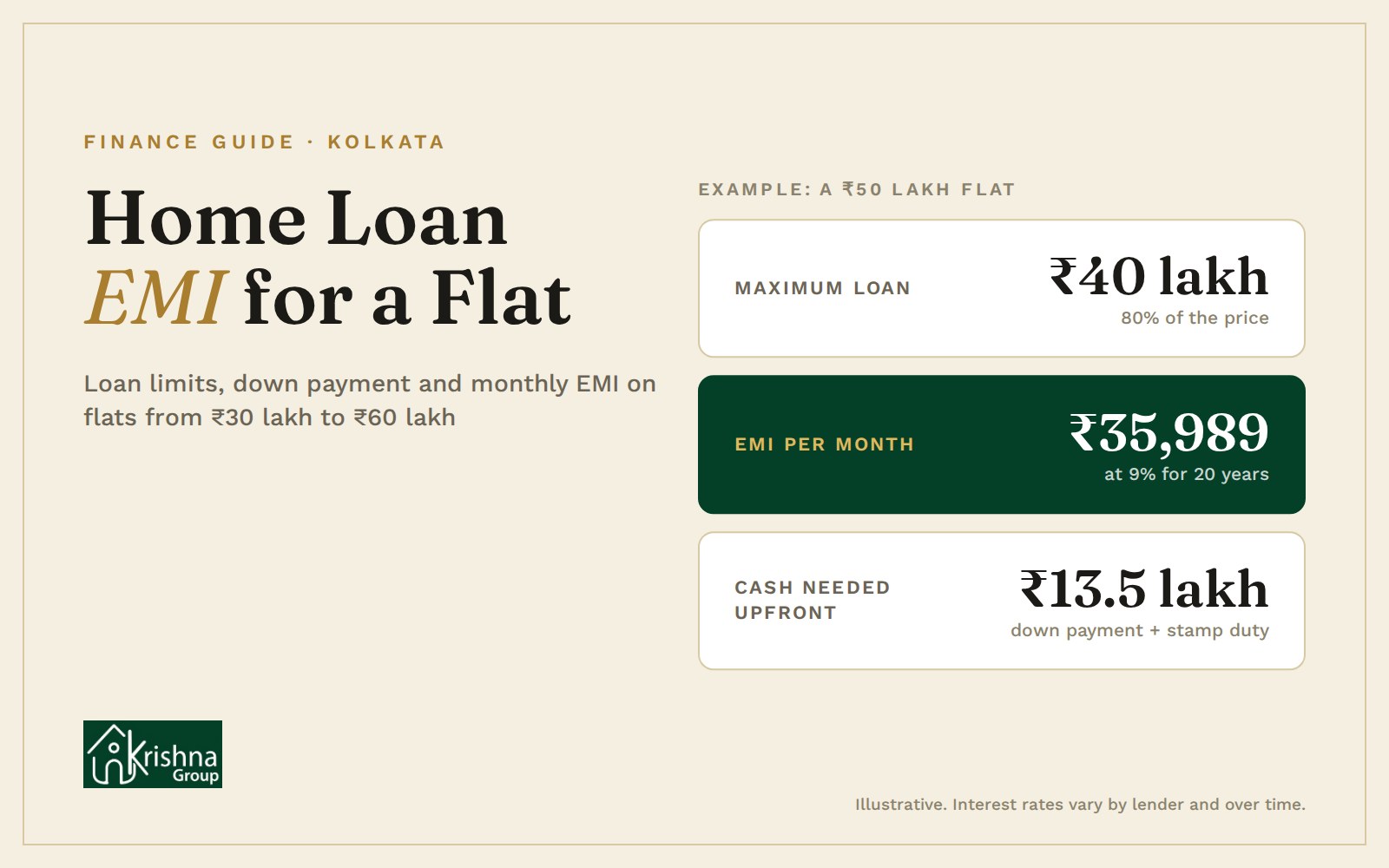
- Know your budget. Use our home loan EMI calculator to find the maximum loan, the down payment and the cash you need upfront, including stamp duty and registration.
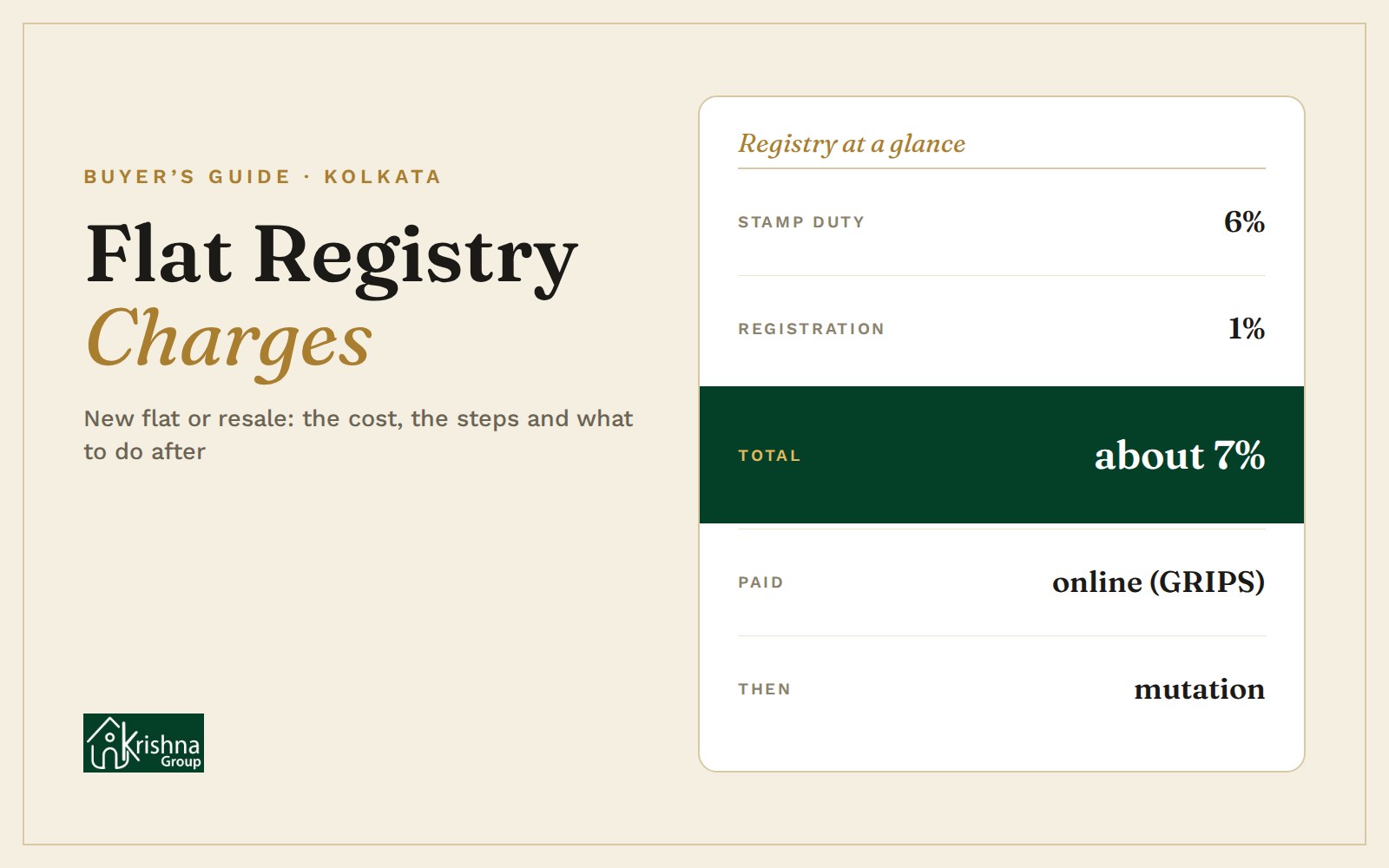
- Plan the registry. Lenders do not finance stamp duty and registration. Read our guide to flat registry charges.
- Check for a subsidy. The interest subsidy under PMAY-Urban 2.0 may apply to eligible households buying flats up to ₹35 lakh. See our guide to 1 BHK flats under ₹30 lakh.
- Verify the flat. Lenders look at the title, the approvals and, for a ready flat, the completion certificate.
A home loan for a Krishna Group flat
Krishna Group can connect buyers with home loan partners. Call +91 91644 89774 or use the contact form to ask. Krishna Group has 149 flats available across five developments in Kestopur, from ₹26 lakh, most of them ready to move. See our guides to flats for sale in Kestopur and apartments for sale in Kestopur. Krishna Group cannot confirm your loan eligibility or rate, which only your lender can do.
Frequently asked questions
What is the home loan interest rate in Kolkata?
It is the same as elsewhere in India, because lenders set rates nationally. In early November 2026 comparison sites showed advertised starting rates of about 7.15 to 7.90 percent for borrowers with strong credit profiles, while most borrowers were offered more, for example 8.75 to 9.65 percent on ICICI Bank’s own page for loans up to 35 lakh rupees. Check the lender’s current page.
Are home loan rates different in Kolkata from other cities?
No. Banks and housing finance companies price home loans nationally. What is local is the property valuation and legal check, not the interest rate.
How did the RBI’s October 2026 hike affect home loan rates?
The RBI raised the repo rate by 0.25 percent to 5.50 percent on 7 October 2026. Floating-rate home loans linked to the repo rate were reset from 8 October, so EMIs or tenures rise unless the lender adjusts otherwise.
How much does a 0.25 percent rise change my EMI?
On a 32 lakh rupee loan over 20 years, a 0.25 percent rise adds about 517 rupees a month and about 1,23,962 rupees over the loan.
What credit score do I need for the lowest home loan rate?
A score of 750 or more is generally needed for the best rates. A lower score may still be approved, usually at a higher rate.
Can Krishna Group help me get a home loan?
Krishna Group can connect buyers with home loan partners. Your lender decides your eligibility and rate. Call +91 91644 89774 to ask.
See a Krishna Group home in Kestopur
Call +91 91644 89774 or book a site visit to see the flats for yourself.

Krishna Group has been building homes in Kolkata since 1988 and has completed 40+ projects. Our five current developments – Krishna Paradise, Krishna Kamdhenu, Krishna Shivangan, Krishna Lakeview and Krishna Heights – are all in Kestopur.